Understanding the site and its context
Moor Lane's character is defined by its idyllic rural location within the landscape of the Cheshire plain. Surrounded by open fields to the north and west, the site offers vistas out across the open fields towards the Lindow Moss nature reserve.
A rich agricultural heritage in the surrounding area is apparent in the abundance of 19th century dairy farmsteads found throughout this landscape. Characterised by farmhouses, workers' cottages, and barns for cattle and hay, these farmsteads formed in a distinct palette of red brick, timber, and pitched slate roofs give the area its distinct architectural character.
The area’s local style is characterised by terracotta brick, gently pitched gable-ends, and sash windows with stone sills and shallow arched openings. Moor Lane House also features several large bay windows and decorative timber roof edging.

WITHIN THE WIDER LANDSCAPE
Farmsteads stand within wider landscapes. The size and density in the landscape of farms and fields, and their character, result from the type of farming practised, with farms ranging from the largest corn producing holding to the smallest dairying or stock rearing outfit. Historical patterns of settlement and land use can reach back into the medieval period and even earlier, although elsewhere there has sometimes been radical change. At the one extreme are areas of dispersed settlement with few or no villages, and here the landscape has always been dominated by scattered hamlets and farmsteads. On the other hand, in areas of nucleated settlement, medieval communities typically worked the land, laid out in open fields, from villages; the modern farming landscape, of enclosed fields and isolated farmsteads, was established only in the last few hundred years. Other areas have a mix of settlement patterns.
A farmstead is the homestead of a farm where the farmhouse and some or all of the working farm buildings are located, some farms having field barns or out-farms sited away from the main steading.
Farmsteads (or steadings as they are known in the northernmost parts of England) perform several basic functions. The farmhouse provides shelter for the farmer and his family, while the agricultural buildings provide for the housing and processing of crops, the storage of vehicles, implements and fodder and the accommodation of livestock.
Building functions fall into two broad types: multi-functional buildings, on the one hand, and specialist buildings on the other.
This latter category includes structures specialising in crop processing and storage (such as barns, hay barns, cider houses, oast houses, maltings and granaries) or designed to accommodate animals (including ox and cow houses, shelter sheds, stables and pig
sties) and birds (dovecots and poultry houses).
FARMSTEAD FORM
Locally, all farmsteads typically have one single farmhouse, which is almost always a large detached two storey brick building. Most have one main barn, generally of two storeys with the upper floor partially within the roof space. Along with the farmhouse, these barns are typically the oldest structures on the farmstead. The main barn is usually complemented by additional single storey barns, outhouses, and/or extensions to the original barn, built at a later date.
The farmhouse’s front elevation generally always faces the farmstead entrance route or lane. Most often the house is built close to the lane to provide direct access, avoiding an approach through the working farmyard. Some farms, particularly those built against lanes, have brick boundary walls which barns or outbuildings are sometimes built against.
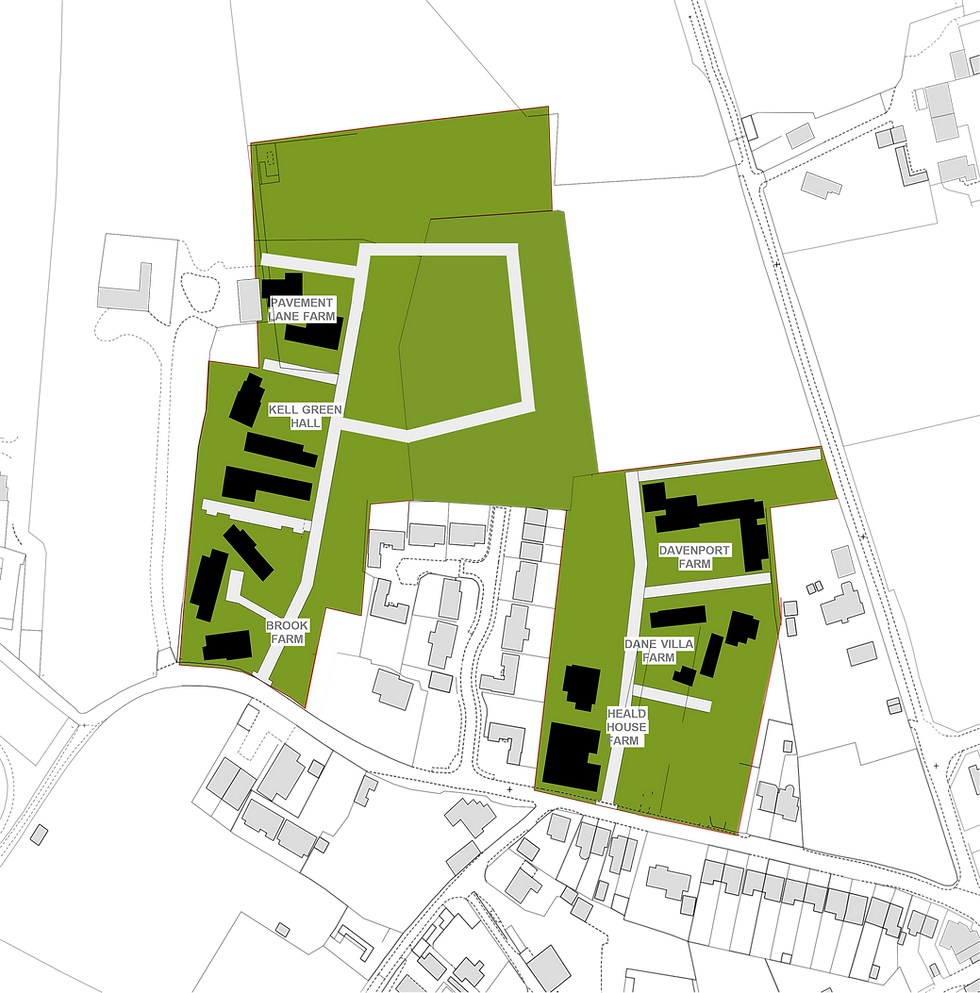
FARMSTEAD LAYOUTS: LOCAL PRECEDENT
Courtyard plans focused around one or more focal working yards for cattle, the collection of their manure (extremely important for fertiliser), and other purposes.
They subdivide into loose courtyard plans with detached buildings – often with irregular site boundaries and resulting from piecemeal development – and regular courtyard plans of interlinked buildings where the buildings and yards often result from one or more phases of replanning.